



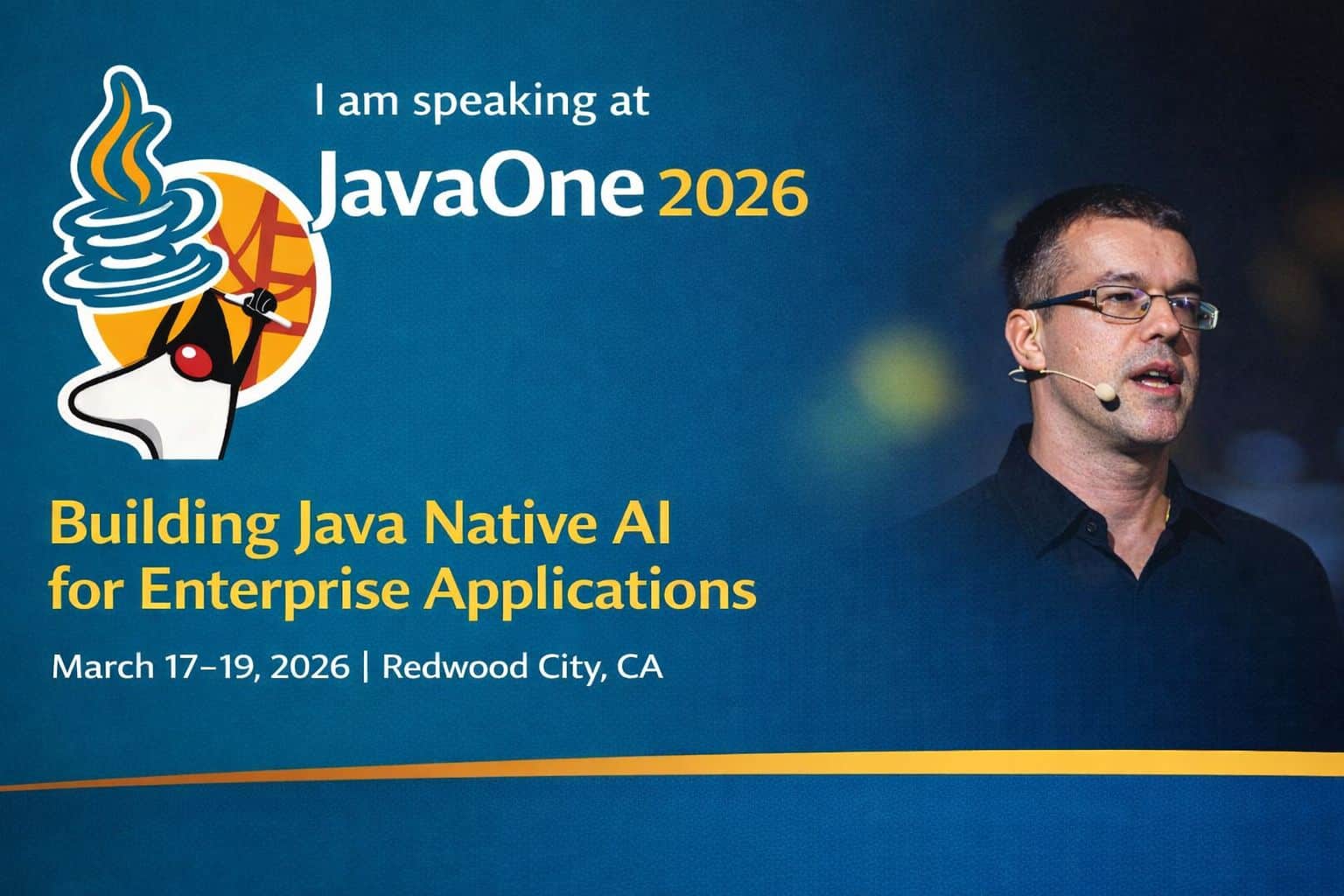
JavaOne 2026: Building Java Native AI for Enterprise Applications

From AI Prototypes to Production: Why Java Matters for Enterprise AI
At Java One 2026, in Building Java Native AI for Enterprise Applications, I’ll show how teams can build and run AI directly in Java, whether you’re moving from prototype to production or bringing an existing model into a Java environment.
From AI Prototypes to Production: Why Java Matters for Enterprise AI
Enterprise teams across the industry are discovering a familiar pattern when adopting AI.
The pilot works beautifully.
The demo impresses stakeholders.
The prototype proves the concept.
But then something unexpected happens.
Production stalls.
This pattern is appearing in many organizations experimenting with AI inside large enterprise systems. The issue usually isn’t the model quality or the algorithms themselves. Modern machine learning frameworks and cloud platforms make it relatively easy to create impressive prototypes.
The real challenge appears after the prototype stage, when teams attempt to integrate AI into real production environments.
The Real Challenge of Enterprise AI
In research or experimentation environments, the goal is often clear: build a model that works and demonstrates value.
Enterprise systems, however, operate under very different constraints.
Production AI must address requirements such as:
Security and governance
Regulatory compliance
Scalability and performance
Reliability and observability
Operational stability
Long-term ownership and maintainability
These requirements transform AI from a research project into an engineering and operational challenge.
In other words, once a model works, the real work begins.
This is where many teams encounter friction. Prototypes built in experimental environments often struggle to fit naturally into existing enterprise architectures.
AI in the Enterprise Is a Factory Problem
A useful way to think about enterprise AI is this:
Research can happen anywhere.
But production is a factory.
Factories need predictable processes, mature tooling, stable infrastructure, and systems that can run reliably for years. They require teams that can maintain, evolve, and support systems over time.
This is exactly the type of problem that the Java ecosystem has been solving for decades.
Java powers a large portion of the world’s enterprise systems precisely because it excels at building reliable, scalable, maintainable platforms. When AI becomes part of enterprise applications, these same qualities become essential.
Building AI Directly in Java
Rather than treating AI as an external system glued onto enterprise applications, many organizations are now exploring Java-native approaches to AI integration.
This means:
- Running AI models within Java applications
- Integrating AI capabilities directly into existing services and platforms
- Leveraging Java’s mature ecosystem for security, scalability, and observability
- Ensuring that AI systems follow the same operational standards as other enterprise services
When AI becomes part of the core application architecture instead of a separate experimental stack, it becomes significantly easier to operate, maintain, and scale.
Join the Conversation at JavaOne
AI adoption in the enterprise is still evolving, and the industry is collectively learning how to move from experimentation to reliable production systems.
Events like JavaOne provide a great opportunity to share experiences, exchange ideas, and explore how the Java ecosystem continues to adapt to new technological challenges.
I’m looking forward to the conversations and discussions that will come out of this session.
📅 JavaOne 2026
📅 March 17–19, 2026
📍 Redwood City, California
If you’re attending JavaOne this year, I hope to see you there.
📅 March 17-19, 2026 | Redwood City, CA