Build a network whose input count matches the feature columns and whose output layer, activation, and loss match the prediction task.
Use a linear output for predicting a continuous numerical value:
import deepnetts.net.FeedForwardNetwork;
import deepnetts.net.layers.activation.ActivationType;
import deepnetts.net.loss.LossType;

FeedForwardNetwork neuralNet = FeedForwardNetwork.builder()
        .addInputLayer(NUM_INPUTS)
        .addOutputLayer(1, ActivationType.LINEAR)
        .lossFunction(LossType.MEAN_SQUARED_ERROR)
        .randomSeed(42)
        .build();
This is the smallest linear regression model. Add hidden layers only when the problem requires a nonlinear relationship.
Use one Sigmoid output to produce a value between zero and one:
FeedForwardNetwork neuralNet = FeedForwardNetwork.builder()
        .addInputLayer(NUM_INPUTS)
        .addFullyConnectedLayer(32)
        .addFullyConnectedLayer(16)
        .addOutputLayer(1, ActivationType.SIGMOID)
        .lossFunction(LossType.CROSS_ENTROPY)
        .randomSeed(42)
        .build();
Interpret the output as a class probability and apply an explicit threshold when choosing the class.
Use one Softmax output per class:
FeedForwardNetwork neuralNet = FeedForwardNetwork.builder()
        .addInputLayer(NUM_INPUTS)
        .addFullyConnectedLayer(16, ActivationType.TANH)
        .addOutputLayer(NUM_CLASSES, ActivationType.SOFTMAX)
        .lossFunction(LossType.CROSS_ENTROPY)
        .randomSeed(42)
        .build();
The order of the outputs must match the order of the one-hot target columns and the class-name mapping used during prediction.
Use ConvolutionalNetwork when the input has spatial structure, such as an
image. Convolutional layers learn local patterns, pooling reduces spatial
dimensions, and fully connected layers combine the learned feature maps before
classification.
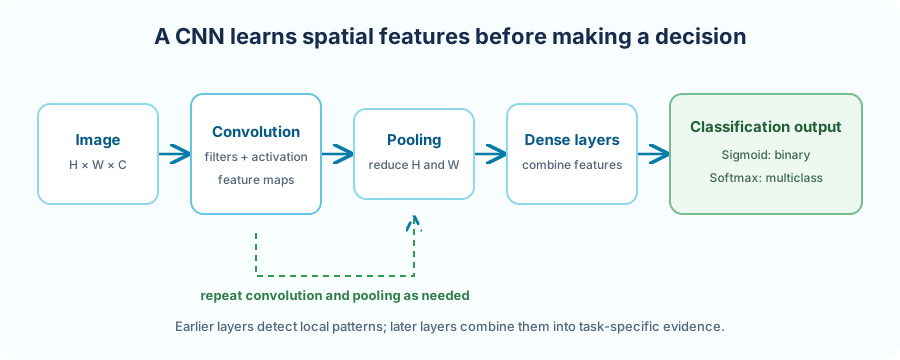
A compact binary image classifier can be built with the current Deep Netts API:
import deepnetts.net.ConvolutionalNetwork;
import deepnetts.net.layers.Filters;
import deepnetts.net.layers.activation.ActivationType;
import deepnetts.net.loss.LossType;

ConvolutionalNetwork network = ConvolutionalNetwork.builder()
        .addInputLayer(width, height, 3)
        .addConvolutionalLayer(6, Filters.ofSize(3))
        .addMaxPoolingLayer(2, 2)
        .addFullyConnectedLayer(16)
        .addOutputLayer(1, ActivationType.SIGMOID)
        .hiddenActivationFunction(ActivationType.LEAKY_RELU)
        .lossFunction(LossType.CROSS_ENTROPY)
        .randomSeed(42)
        .build();
| Builder step | Responsibility |
|---|---|
addInputLayer(width, height, 3) |
Declares RGB image dimensions and channels |
addConvolutionalLayer(6, Filters.ofSize(3)) |
Learns six local 3 × 3 filters |
addMaxPoolingLayer(2, 2) |
Reduces feature-map width and height |
addFullyConnectedLayer(16) |
Combines extracted spatial features |
addOutputLayer(1, SIGMOID) |
Produces one binary-class probability |
For grayscale input, use one channel. For multiclass classification, use one Softmax output per class:
.addInputLayer(width, height, 1)
// convolution, pooling, and fully connected layers
.addOutputLayer(NUM_CLASSES, ActivationType.SOFTMAX)
.lossFunction(LossType.CROSS_ENTROPY)
The output order must remain identical to the class-label mapping used by the dataset and prediction code. Add another convolution-and-pooling block only when the image size and problem complexity justify the additional capacity.
Use a fixed random seed when you want reproducible weight initialization while comparing changes.
1 -> 1 linear model.Use Linear for regression, Sigmoid for binary classification, and Softmax for mutually exclusive multiclass classification.
The input size must match the number of prepared numerical features or the exact dimensions of the image tensor.
Was this helpful?
Thank you!