Prepare data after loading it and before building or training a model. The safe order is:
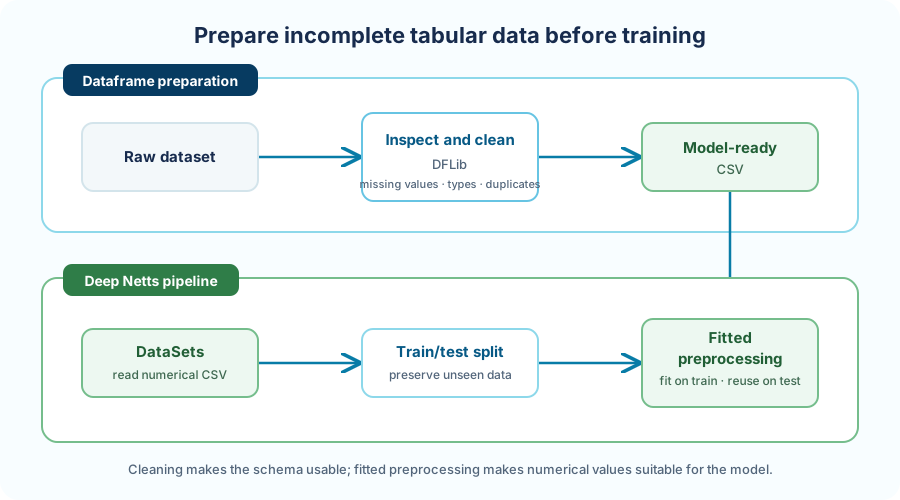
Deep Netts expects model-ready numerical features and targets. If a raw CSV has
missing cells, invalid sentinel values, duplicated rows, inconsistent types, or
extra columns, clean it with a dataframe tool before calling
DataSets.readCsv.
Before exporting the model-ready CSV, confirm:
DFLib is already used by the Sorting Execution Time example. It can select, rename, transform, join, drop, and fill columns or rows before exporting model-ready data.
DFLib prepares the raw table. It does not replace Deep Netts
Standardizer, MinMaxScaler, dataset splitting, training, or evaluation.
The Sorting Execution Time project already uses DFLib to select the feature and target in their required order. The same pipeline can apply a domain-defined missing-value rule before exporting a generated CSV:
import org.dflib.DataFrame;
import org.dflib.csv.Csv;

DataFrame modelData = Csv.load(RAW_DATASET_PATH)
        .cols("comparison_count", "execution_time_ms")
        .select()
        .cols("execution_time_ms")
        .fillNulls(0.0);

Csv.saver()
        .createMissingDirs()
        .save(modelData, CLEAN_DATASET_PATH);
Use a constant such as 0.0 only when the domain says that it has a real
meaning. Do not use it merely because a cell is empty.
For ordered measurements where carrying a neighboring observation is valid, DFLib also provides forward and backward filling:
DataFrame modelData = rawData
        .cols("sensor_value")
        .fillNullsForward()
        .cols("target")
        .fillNullsBackwards();
Forward or backward filling is appropriate only when row order has a real temporal or sequential meaning. It is usually wrong for independently sampled rows.
After DFLib exports the expected numerical columns, continue with the normal Deep Netts workflow:
TabularDataSet<MLDataItem> dataSet = DataSets.readCsv(
        CLEAN_DATASET_PATH,
        NUM_INPUTS,
        NUM_OUTPUTS,
        true,
        ",");
The selected column order is part of the model contract: input columns come first and target columns come last.
Schema corrections, selecting columns, mapping a known sentinel value, and domain-defined constants can be applied before the train/test split when they do not learn anything from the dataset.
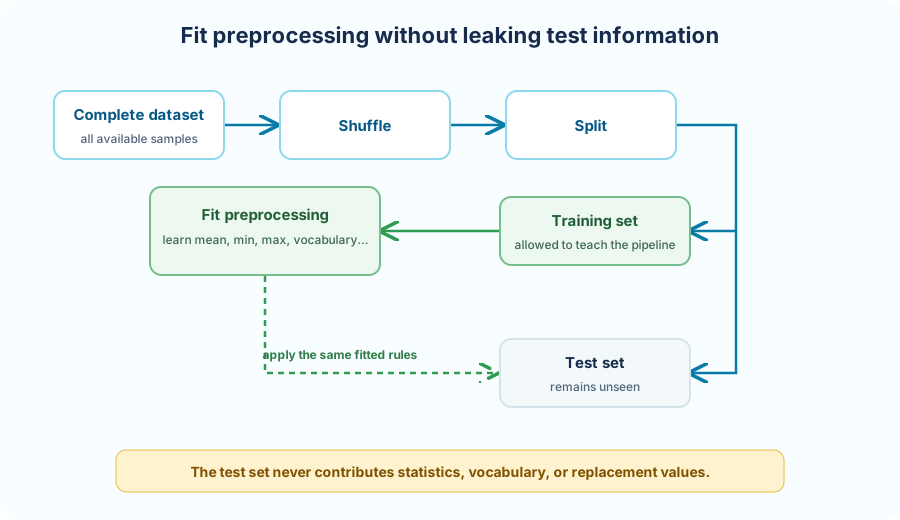
Mean, median, mode, frequency, and other data-derived replacement values must be calculated from the training subset only. Save those learned values and apply them unchanged to the test subset and future prediction data. Calculating them from the complete table lets test information affect training.
There is no universally correct missing-value strategy. Choose it from the meaning of the column, why values are missing, how much data would be lost, and how the model will receive future inputs.
Use a fixed seed when shuffling so repeated runs create the same ordering:
import deepnetts.data.MLDataItem;
import deepnetts.data.TrainTestSplit;
import javax.visrec.ml.data.DataSet;

dataSet.shuffle(42);

TrainTestSplit split = dataSet.trainTestSplit(0.8);
DataSet<MLDataItem> trainingSet = split.getTrainingSet();
DataSet<MLDataItem> testSet = split.getTestSet();
The value 0.8 assigns 80% of the samples to training and reserves 20% for evaluation. Never train on testSet.
For an ImageSet, use the corresponding image split:
images.shuffle(42);
ImageSet[] split = images.split(0.8, 0.2);
ImageSet trainingSet = split[0];
ImageSet testSet = split[1];
Image width, height, channel order, value scaling, and label mapping are part of
the model input contract. Apply the same fixed transformations to training,
test, and future prediction images. If a transformation learns statistics from
the dataset, fit those statistics on trainingSet only. Apply data augmentation
only to training images, after the split.
Standardization is useful when numerical features have different means and scales:
import deepnetts.data.norm.Standardizer;

Standardizer standardizer = new Standardizer(trainingSet);
standardizer.apply(trainingSet);
standardizer.apply(testSet);
Constructing the standardizer from trainingSet ensures that the test data does not influence the learned transformation.
The classification examples use Min-Max scaling:
import deepnetts.data.DataSets;
import deepnetts.data.norm.MinMaxScaler;

MinMaxScaler scaler = DataSets.scaleToMinMax(trainingSet);
scaler.apply(testSet);
scaleToMinMax(trainingSet) fits the scaler and transforms the training set. Apply that same scaler to the test set.
Do not fit a standardizer or scaler on the complete dataset before splitting. Doing so lets information from the test samples influence training and makes evaluation look more reliable than it is.
Keep the fitted preprocessing object. Attach it to the trained model before saving so new prediction inputs receive the same transformation.
Standardizer.MinMaxScaler on training data before transforming the test set.MinMaxScaler.[0, 1].Shuffle, split, fit preprocessing on the training set, and then apply the fitted transformation to the test set.
Leakage occurs when information from test samples influences training or preprocessing, making evaluation results unrealistically optimistic.
Was this helpful?
Thank you!