The cookbook examples predict numbers and classify existing inputs. Generative AI uses the same learning foundations to create new text, images, audio, code, or other data.
Scope of this lesson
Deep Netts demonstrates the neural-network foundations and a small sequence-prediction concept here. This cookbook does not contain a runnable Transformer or Large Language Model project. External LLM services are not built-in Deep Netts features, and their snippets below are architectural illustrations.
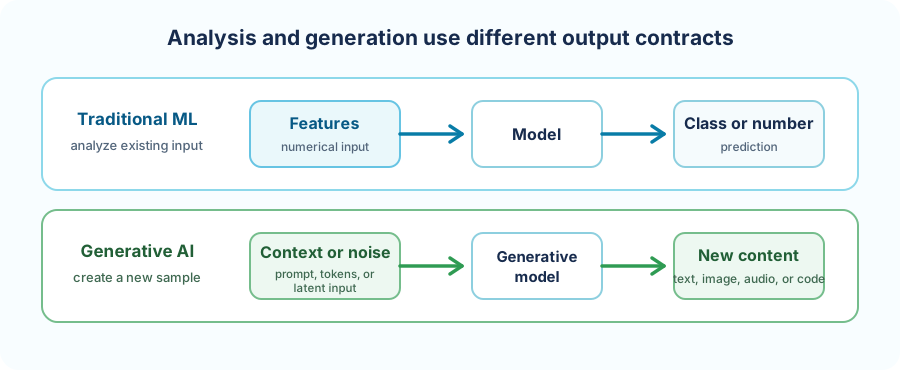
Text generation is commonly next-token prediction. Given tokens \(x_1,\ldots,x_t\), the model estimates:
Input:  "The cat sat on the"
Model:  P("mat") = 0.35, P("floor") = 0.25, P("chair") = 0.20, ...
Sample: "mat"
The chosen token is appended to the context and prediction repeats until a sequence is complete.
| Course concept | Generative role |
|---|---|
| Inputs | Tokens, pixels, audio samples, latent values, or conditioning data |
| Weights and biases | Parameters that encode learned patterns |
| Activations | Nonlinear transformations inside model blocks |
| Softmax | Probability distribution over possible next tokens |
| Cross-entropy | Common next-token loss |
| Backpropagation | Calculates gradients through the complete model |
| Optimizer | Updates parameters from gradients |
Generative systems operate at much larger architecture, data, compute, and parameter scales than the examples in this course, but the forward-pass, loss, backpropagation, and optimization loop remains recognizable.
| Family | Typical output | Main idea |
|---|---|---|
| Large Language Models | Text and code | Predict or sample tokens from context |
| Diffusion models | Images, audio, and video | Reverse a gradual noising process |
| Generative Adversarial Networks | Images and synthetic data | Generator competes with discriminator |
| Variational Autoencoders | Images and latent representations | Learn a structured latent probability space |
Each family needs an architecture and objective suited to its data and generation process.
Transformers are the dominant architecture for current text generation. Attention lets every token weigh relevant information from other positions rather than relying only on a fixed sequential state.
"The cat, which was very old and tired, sat on the ___"
       ^                                        ^
       +----------- relevant context -----------+
A Transformer combines attention, learned projections, feed-forward layers, residual connections, normalization, and positional information.
Every token representation produces:
Scaled dot-product attention is:
Without scaling, dot products tend to grow with vector width, pushing Softmax toward regions with tiny gradients.
Several attention operations run in parallel:
Different heads can learn local syntax, long-range references, or other relationships. Their outputs are combined into one representation.
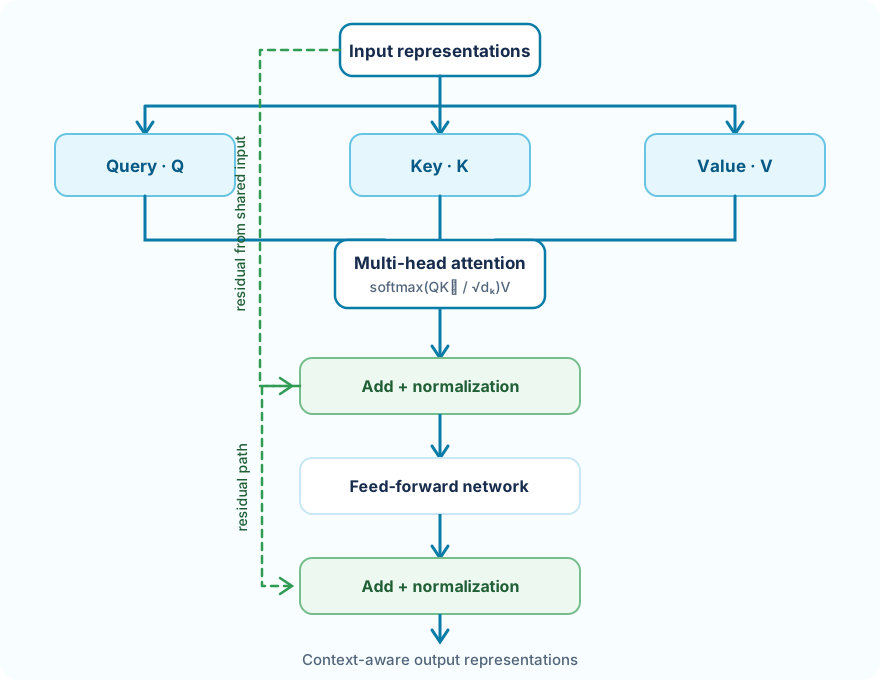
The feed-forward component uses the same weighted sums, nonlinear activations, and backpropagation principles as the Deep Netts models in this course. Attention adds sequence-aware context that the simple cookbook networks do not implement.
An autoregressive model predicts every next token:
This is cross-entropy applied across a large vocabulary. Backpropagation sends gradients through every Transformer block.
After pre-training, models can be adapted with supervised fine-tuning, preference data, reinforcement-learning methods, or other alignment techniques. Pipelines differ by model and provider, but they build on the pre-trained token predictor.
Temperature \(T\) rescales token logits \(z_i\) before Softmax:
| Temperature | Typical effect |
|---|---|
| Low positive value | Sharper distribution and repeatable choices |
| \(T=1\) | Original learned distribution |
| Higher value | Flatter distribution and more variation |
Production APIs may also offer top-\(k\), top-\(p\), repetition penalties, stop sequences, and provider-specific deterministic decoding.
A small feed-forward network can illustrate sliding-window prediction. It is not a Transformer, LLM, or general text generator.
x1,x2,x3,next
1,1,2,3
1,2,3,5
2,3,5,8
3,5,8,13
5,8,13,21
Load and preprocess using the current Deep Netts 4 pattern:
TabularDataSet<MLDataItem> dataSet = DataSets.readCsv(
        "sequence.csv", 3, 1, true, ",");

dataSet.shuffle(42);
TrainTestSplit split = dataSet.trainTestSplit(0.8);
DataSet<MLDataItem> trainingSet = split.getTrainingSet();
DataSet<MLDataItem> testSet = split.getTestSet();

Standardizer standardizer = new Standardizer(trainingSet);
standardizer.apply(trainingSet);
standardizer.apply(testSet);
Build a nonlinear regression model:
FeedForwardNetwork neuralNet = FeedForwardNetwork.builder()
        .addInputLayer(3)
        .addFullyConnectedLayer(8, ActivationType.RELU)
        .addFullyConnectedLayer(4, ActivationType.RELU)
        .addOutputLayer(1, ActivationType.LINEAR)
        .lossFunction(LossType.MEAN_SQUARED_ERROR)
        .randomSeed(42)
        .build();

neuralNet.getTrainer()
        .setStopEpochs(5000)
        .setLearningRate(0.001f)
        .setOptimizer(OptimizerType.SGD)
        .setShuffle(true);

neuralNet.train(trainingSet);
RegressionMetrics metrics = (RegressionMetrics) neuralNet.test(testSet);

neuralNet.setNormalizer(standardizer);
float[] sequenceWindow = {5f, 8f, 13f};
float nextValue = neuralNet.predict(sequenceWindow)[0];
This demonstrates how previous values become features. Serious sequence modeling also requires representative data, careful evaluation, and a sequence-aware architecture.
Real applications often call a pretrained model through a provider API. Endpoint paths, headers, request schemas, model identifiers, pricing, and controls are provider-specific and can change.
String endpoint = System.getenv("LLM_API_URL");
String apiKey = System.getenv("LLM_API_KEY");

String requestBody = """
        {
          "model": "MODEL_ID",
          "messages": [{
            "role": "user",
            "content": "Explain neural networks for a Java developer."
          }]
        }
        """;

HttpRequest request = HttpRequest.newBuilder()
        .uri(URI.create(endpoint))
        .header("Authorization", "Bearer " + apiKey)
        .header("Content-Type", "application/json")
        .POST(HttpRequest.BodyPublishers.ofString(requestBody))
        .build();

HttpResponse<String> response = HttpClient.newHttpClient().send(
        request, HttpResponse.BodyHandlers.ofString());
Production code must handle secrets, JSON serialization, timeouts, retries, unsuccessful status codes, rate limits, privacy, observability, and response validation. Never commit API keys.
Deep Netts can produce a structured prediction, while an external LLM turns approved facts into natural language:
features -> Deep Netts -> prediction and metrics
                              |
                              v
                     approved prompt context
                              |
                              v
                       external LLM -> explanation
float[] irisFeatures = {5.1f, 3.5f, 1.4f, 0.2f};
float[] probabilities = classifier.predict(irisFeatures);
int predictedClass = argMax(probabilities);
float confidence = probabilities[predictedClass];

String prompt = String.format(
        "The classifier predicted class %d with %.1f%% confidence. "
        + "Explain the result using only these supplied facts.",
        predictedClass, confidence * 100);

// Send the prompt through an explicitly configured external LLM client.
Generated explanations do not replace model metrics or domain validation. Send only policy-approved data and review output before consequential use.
Machine Learning Basics         -> data, targets, and evaluation
Linear Regression               -> the smallest trainable neuron
Logistic Regression             -> binary probabilities and decision boundaries
Neural Networks                 -> hidden layers and representations
Backpropagation                 -> gradients and parameter updates
Convolutional Neural Networks   -> spatial features and image classification
Deep Netts API                  -> Java model-development components
Model Development               -> reproducible end-to-end workflow
Natural Language Processing     -> tokens, representations, and language tasks
Generative AI                   -> sequence generation and attention at scale
Generative AI builds on probability distributions, differentiable layers, losses, backpropagation, optimization, and evaluation, then adds architectures designed for generation.
Use the Examples gallery for verified Deep Netts workflows available in this repository before exploring specialized generative frameworks or hosted models.
Was this helpful?
Thank you!